Seven Gaps Between a Website Visitor and a Job Worth Calling Back
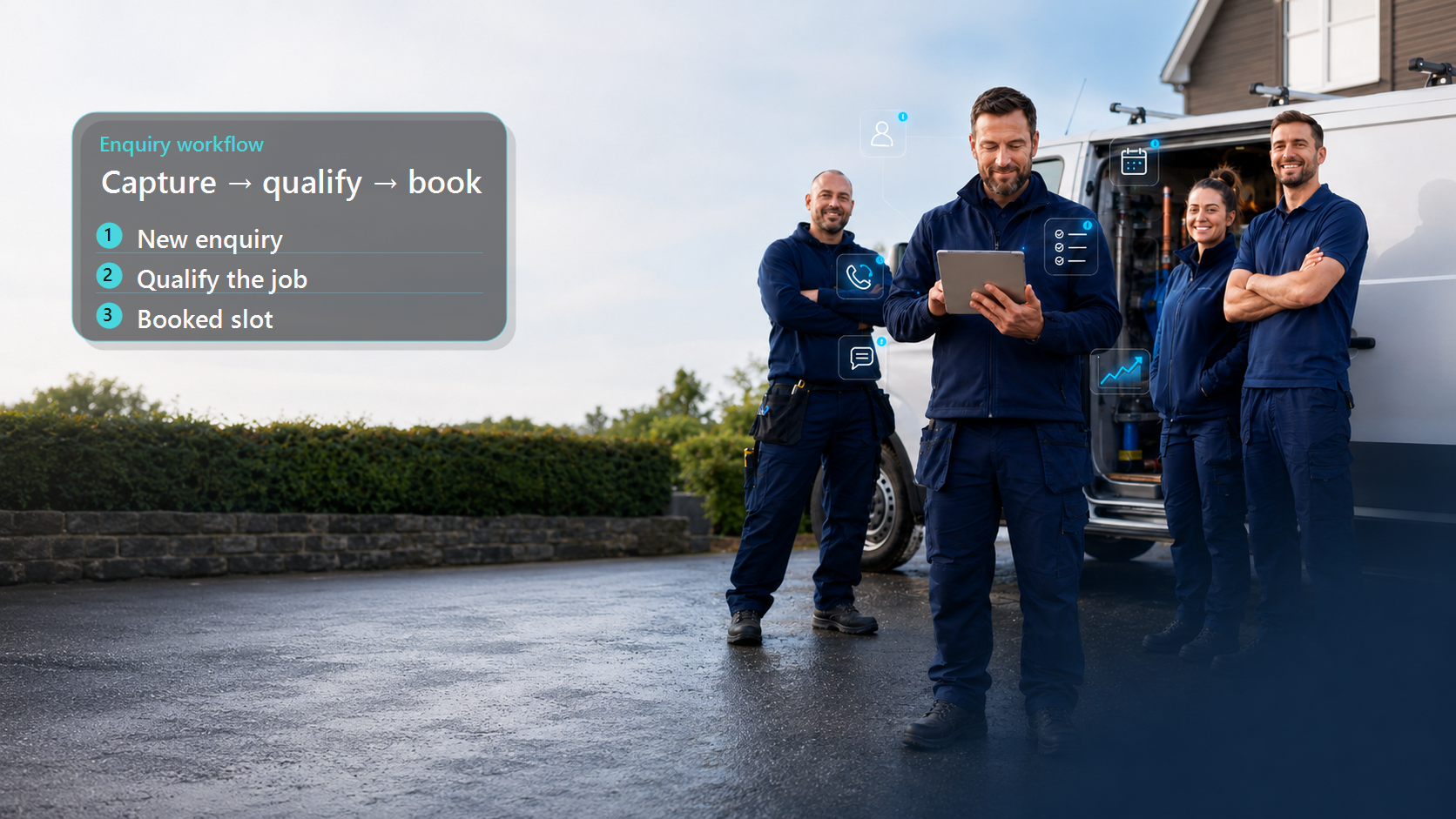
Most plumbing and heating firms do not lose work because the job was too hard. They lose it because nobody answered the website properly while the owner was on-site, driving, or already in a loft.
That is a different problem from "we need AI." It is a coverage problem. Someone visited your site with no hot water or a visible leak, asked for help, and got silence — or a contact form that went nowhere useful until tomorrow.
The seven sections below are the gaps we see most often between a website visitor and a job worth calling back. They are not a shopping list of software features. They are where enquiries quietly die.
1. The first reply has to happen without you
If you are under a sink when the enquiry comes in, the customer does not wait politely. They message the next firm.
A useful website assistant does not need to book the job for you. It needs to reply straight away, sound like your business, and start asking the questions your office would ask — service type, urgency, postcode, what is actually wrong.
That alone keeps you in the conversation while you are still on the tools.
2. Vague enquiries waste the callback
"Boiler not working" is not enough to quote, route, or decide whether to bump another job.
The firms that move fastest are not guessing on the phone. They already know whether it sounds like no heating, a leak, a pressure issue, or a full replacement conversation — plus where the property is and how urgent it feels.
Collecting that on the website, before anyone calls back, turns a vague form submission into something your team can act on in one pass.
3. After-hours is where urgent work picks a winner
Heating failures and burst pipes do not wait for Monday morning.
On a Sunday evening, homeowners often contact several firms at once. The one that wins is rarely the cheapest. It is the one that confirmed the basics, explained what happens next, and made the customer feel the enquiry landed somewhere competent.
You do not need to be in the office at 9pm. You do need the website to keep working when you are not.

A short, sensible exchange overnight — postcode, urgency, preferred time, brief description — is often enough to stop the lead going cold before your first coffee.
4. Photos save a second visit and a wasted slot
Plumbing and heating jobs are unusually visual. A boiler fault code, a leak under a unit, a radiator that will not heat, a pipe that has already been patched badly — all of that matters before you dispatch someone.
Most contact forms do not ask for photos. Most voicemail does not capture them at all. By the time you ask on the callback, the customer has moved on or cannot find the image again.
Getting photos during the first conversation is one of the highest-leverage things a website assistant can do for this trade.
5. Your inbox should hand you a summary, not a puzzle
The failure mode is familiar: enquiry in one place, details in a text thread, photos in a separate email, urgency only mentioned once and never written down.
When you finally call back, you are reconstructing the job from fragments. That costs time, sounds unprofessional, and makes it easy to miss the one detail that would have changed how you booked it.
A clean lead summary — who they are, where they are, what they need, how urgent it is, what they sent — is admin reduction in the only form that matters for a small firm.
6. Better intake makes the diary less chaotic
A messy diary is often a symptom, not the root problem. Jobs get forced into the wrong slots because the enquiry never arrived with enough context.
Postcode, access notes, urgency, and preferred timing should be settled before the calendar gets involved. Then the office is placing work, not interrogating a half-empty form at 8:15am.
This is not about AI running your schedule. It is about not booking blind.
7. The win is a qualified enquiry, not a chatbot demo
The useful test is boring and worth measuring: did the business get enough detail to call back confidently?
Not "did we use AI." Not "did the widget look modern." Did you receive a plumbing or heating enquiry with contact details, postcode, urgency, job description, and photos when you were too busy to answer the site yourself?
If yes, the system did its job. If not, it is just another thing to check.
Where Kerviqa fits
Kerviqa is built for that exact handoff. We install a done-for-you enquiry assistant on your website, tailor it to your plumbing or heating services, and set it up to capture the details your team needs while you are on-site, busy, or closed.
Visitors get a straight reply. You get a structured lead summary by email — service type, urgency, postcode, preferred time, description, and photos where relevant.
We are not trying to replace your office, run your accounts, or become a full CRM. The point is narrower and more useful: stop losing website enquiries because nobody was there to answer them properly.
If one of these sounds familiar
You do not need to fix all seven at once. Most firms feel one gap hardest — usually the slow first reply, the vague form, or the Monday-morning scramble to work out what the customer actually meant.
Start there. That is also where a website assistant earns its keep fastest.
If you want to see how it works on a real plumbing or heating site, apply for a guided beta trial and we will set it up with your services and typical enquiries.
Never miss another plumbing or heating enquiry while you're on-site
Start a guided beta trial — we set it up on your site, tailor it to your services, and keep it running for £49/month after the trial.
Apply for beta trial